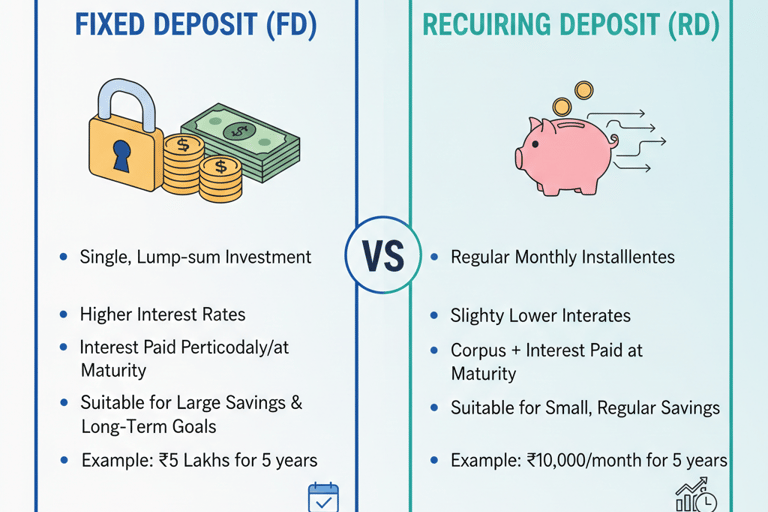
Difference Between Fixed Deposit (FD) and Recurring Deposit (RD)
When it comes to safe and reliable investment options in India, Fixed Deposits (FD) and Recurring Deposits (RD) are among the most popular choices. Both are offered by banks and post offices and are considered low-risk investment instruments. However, they serve different financial needs and suit different types of investors.
flixahdevelopers
1/25/20262 min read
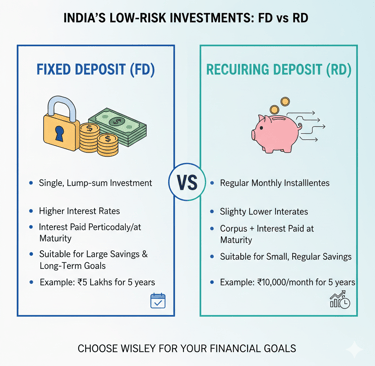
Difference Between Fixed Deposit (FD) and Recurring Deposit (RD)
When it comes to safe and reliable investment options in India, Fixed Deposits (FD) and Recurring Deposits (RD) are among the most popular choices. Both are offered by banks and post offices and are considered low-risk investment instruments. However, they serve different financial needs and suit different types of investors.
If you are confused about which one to choose, this blog will help you understand the key differences between FD and RD, their features, benefits, and which option is better for you.
What is a Fixed Deposit (FD)?
A Fixed Deposit is a lump-sum investment where you deposit a fixed amount of money for a predetermined period at a fixed interest rate. The money remains locked in for the chosen tenure, and you receive the principal along with interest at maturity.
Key Features of FD
One-time lump sum investment
Fixed interest rate throughout the tenure
Tenure ranges from 7 days to 10 years
Interest can be paid monthly, quarterly, or at maturity
Premature withdrawal allowed (with penalty)
Who Should Choose FD?
People with surplus funds
Retired individuals looking for stable income
Conservative investors
Those who want guaranteed returns
What is a Recurring Deposit (RD)?
A Recurring Deposit allows you to invest a fixed amount every month for a specific period. It is designed to encourage regular savings and is ideal for salaried individuals or those with a steady monthly income.
Key Features of RD
Monthly investment of a fixed amount
Fixed interest rate similar to FD
Tenure usually ranges from 6 months to 10 years
Encourages disciplined saving habits
Lump sum received at maturity
Who Should Choose RD?
Salaried individuals
First-time investors
People with monthly income but no lump sum
Those saving for short- or medium-term goals
FD vs RD: Key Differences Explained
FeatureFixed Deposit (FD)Recurring Deposit (RD)Investment StyleOne-time lump sumMonthly installmentsMinimum InvestmentHigher (varies by bank)Lower (can start from ₹500)Ideal ForPeople with surplus moneySalaried or small saversInterest CalculationOn full amount from startOn monthly depositsLiquidityPremature withdrawal allowedPremature closure possibleDiscipline RequiredLowHighMaturity AmountDepends on lump sum & tenureAccumulated monthly savings
Interest Rates: FD vs RD
Generally, FD and RD interest rates are similar, but returns from FD are usually higher because the entire amount earns interest for the full tenure. In RD, each monthly deposit earns interest for a different duration, resulting in slightly lower overall returns.
Taxation on FD and RD
Both FD and RD are taxable investments.
Interest earned is added to your income
Tax deducted at source (TDS) if interest exceeds the prescribed limit
Senior citizens get higher interest rates and higher TDS exemption limits
Tax-saving FD (5-year FD) offers deduction under Section 80C
RD does not offer tax benefits
FD or RD: Which is Better?
There is no one-size-fits-all answer. The right option depends on your financial situation and goals.
Choose FD if:
You have a lump sum available
You want higher returns
You are risk-averse
You want predictable income
Choose RD if:
You want to build savings gradually
You have a monthly income
You want to develop saving discipline
You are planning for future expenses like education or travel
FD and RD for Financial Planning
Both FD and RD play an important role in a balanced financial plan:
FD helps preserve capital and generate stable returns
RD helps inculcate regular saving habits
Both are ideal for short- to medium-term goals
They act as a safety net in uncertain market conditions
For long-term wealth creation, however, investors may also consider diversifying into options like mutual funds, real estate, or equities.
Conclusion
Both Fixed Deposits and Recurring Deposits are safe, reliable, and easy-to-understand investment options. The main difference lies in how you invest the money—lump sum versus monthly savings.
If you have spare funds and want guaranteed returns, FD is a better choice. If you want to save small amounts regularly and build a corpus over time, RD is ideal.
Understanding the difference between FD and RD will help you make smarter financial decisions and align your investments with your financial goals.