Exchange Traded Funds (ETFs)
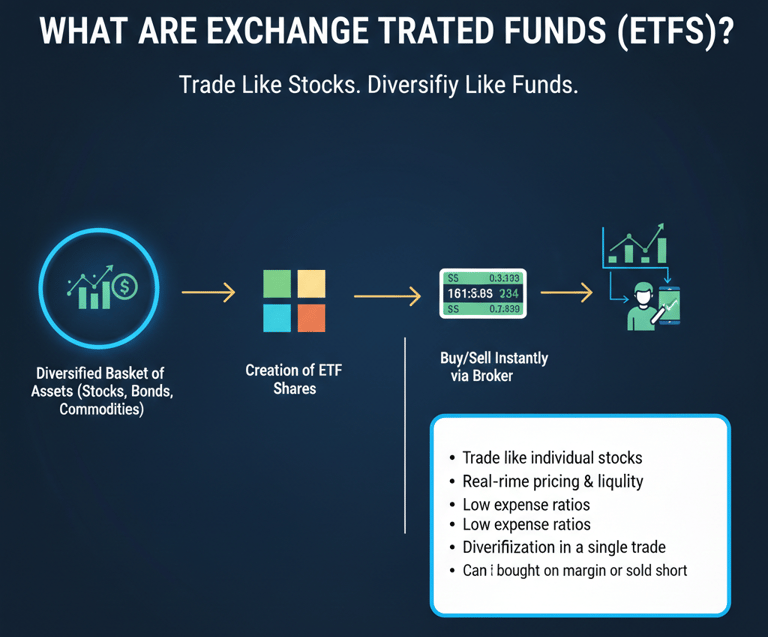
An Exchange Traded Fund (ETF) is an investment fund that is traded on stock exchanges, just like shares. An ETF holds a basket of assets such as stocks, bonds, commodities, or a combination of these. The primary objective of an ETF is to track the performance of a specific index, sector, commodity, or asset class.
flixahdevelopers
1/31/20263 min read
Exchange Traded Funds (ETFs): A Smart and Flexible Investment Option
In today’s fast-changing financial world, investors are constantly looking for investment options that offer flexibility, transparency, and diversification. One such investment product that has gained massive popularity globally and in India is the Exchange Traded Fund (ETF). ETFs combine the features of both stocks and mutual funds, making them an attractive choice for beginners as well as experienced investors.
What Are Exchange Traded Funds (ETFs)?
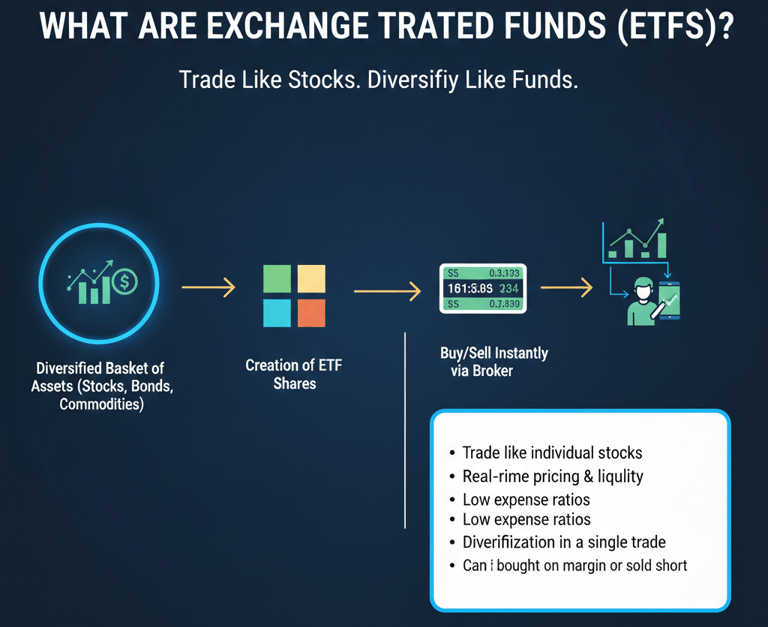
An Exchange Traded Fund (ETF) is an investment fund that is traded on stock exchanges, just like shares. An ETF holds a basket of assets such as stocks, bonds, commodities, or a combination of these. The primary objective of an ETF is to track the performance of a specific index, sector, commodity, or asset class.
For example:
Nifty 50 ETF tracks the Nifty 50 index
Sensex ETF tracks the BSE Sensex
Gold ETF tracks the price of gold
Bank Nifty ETF tracks banking sector stocks
When you invest in an ETF, you are indirectly investing in all the securities included in that ETF.
How Do ETFs Work?
ETFs are listed on stock exchanges and can be bought or sold during market hours at real-time prices. Unlike mutual funds, which are purchased at the end-of-day Net Asset Value (NAV), ETFs allow intraday trading.
ETFs usually follow a passive investment strategy, meaning they track an index rather than trying to outperform it. The fund manager’s role is limited to ensuring the ETF mirrors the index as closely as possible.
Key Features of ETFs
Traded Like Stocks
ETFs can be bought and sold anytime during market hours, offering high liquidity and flexibility.Low Cost
Most ETFs have a lower expense ratio compared to actively managed mutual funds, as they follow a passive strategy.Diversification
ETFs provide instant diversification by investing in multiple securities through a single investment.Transparency
The holdings of ETFs are disclosed daily, allowing investors to know exactly where their money is invested.
Types of ETFs
There are different types of ETFs available to suit various investment goals:
Equity ETFs: Track stock market indices like Nifty 50 or Sensex
Sector ETFs: Focus on specific sectors such as banking, IT, or pharma
Commodity ETFs: Invest in commodities like gold or silver
Bond ETFs: Track government or corporate debt securities
International ETFs: Provide exposure to global markets
Benefits of Investing in ETFs
One of the biggest advantages of ETFs is cost efficiency. Since they are passively managed, investors save on fund management charges, which improves long-term returns.
ETFs also offer flexibility. Investors can use different strategies like buying on dips, setting limit orders, or selling instantly during market hours.
Another key benefit is tax efficiency. Due to lower portfolio turnover, ETFs generally generate fewer capital gains compared to actively managed funds.
ETFs are also suitable for long-term wealth creation when held for several years, especially index-based ETFs.
Risks Associated with ETFs
Although ETFs are considered relatively safe, they are not free from risks. Since ETFs are market-linked instruments, their value fluctuates with market movements.
Liquidity risk may arise in ETFs that have low trading volumes. Additionally, tracking error—the difference between ETF performance and the underlying index—can slightly impact returns.
Investors should also consider brokerage charges and demat account requirements before investing.
ETFs vs Mutual Funds
The main difference between ETFs and mutual funds lies in trading and pricing. ETFs are traded on exchanges at market prices, while mutual funds are bought at NAV.
ETFs usually have lower expense ratios and higher transparency, whereas mutual funds offer the convenience of SIPs without needing a demat account (though ETF SIPs are now possible via brokers).
Who Should Invest in ETFs?
ETFs are ideal for:
Investors looking for low-cost, diversified investments
Long-term investors aiming for steady market-linked returns
Active traders who want intraday flexibility
Beginners who want exposure to markets without picking individual stocks
Conclusion
Exchange Traded Funds (ETFs) are a powerful investment tool that combines the simplicity of mutual funds with the flexibility of stocks. They offer diversification, transparency, and cost efficiency, making them suitable for a wide range of investors.
Whether you are a beginner starting your investment journey or an experienced investor looking to optimize your portfolio, ETFs can play a valuable role in achieving your financial goals.
for more info on real estate investment please visit our website flixahdeveloperspvtltd.com and you can also reach us at +91 9100600730