
India’s Housing Market in 2026: Trends, Growth Drivers & Future Outlook
India’s housing market has undergone a remarkable transformation in the past decade. What was once considered a slow-moving, unpredictable sector has now emerged as one of the most resilient and fastest-growing industries in the country. Driven by rising income levels, rapid urbanisation, infrastructure upgrades, and positive government interventions, the Indian housing market continues to show strong momentum.
flixah developers
12/9/20254 min read
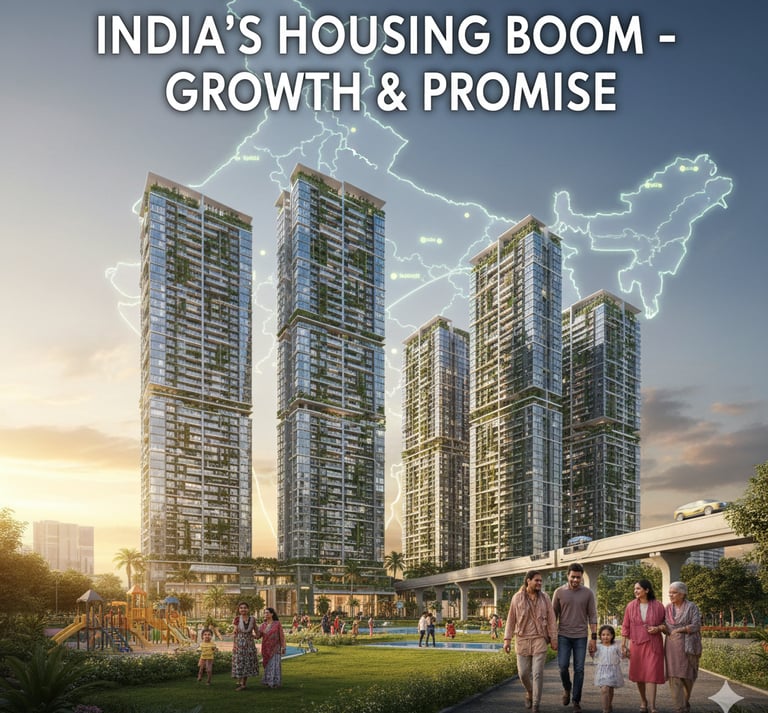
India’s Housing Market in 2026: Trends, Growth Drivers & Future Outlook
India’s housing market has undergone a remarkable transformation in the past decade. What was once considered a slow-moving, unpredictable sector has now emerged as one of the most resilient and fastest-growing industries in the country. Driven by rising income levels, rapid urbanisation, infrastructure upgrades, and positive government interventions, the Indian housing market continues to show strong momentum.
As we move into 2026, homebuyers, investors, developers, and NRIs are all asking one major question:
Is India’s housing market still a strong investment opportunity?
The answer is a clear yes. This blog explores the key trends, price movements, demand drivers, and the future outlook of the housing sector in India.
1. Strong Demand Across All Major Cities
In 2024 and 2025, India saw record-high housing sales across metros such as Mumbai, Pune, Hyderabad, Bengaluru, NCR, and Chennai. This trend continues into 2026 due to:
Increasing household incomes
Larger home requirements after the pandemic
Growing IT and corporate job opportunities
More young buyers entering the market
Rising aspirations for luxury and branded homes
Cities like Hyderabad, Bengaluru, and Pune are recording the highest YOY growth in new launches and sales, thanks to strong employment creation, especially in IT, biotech, and financial services.
2. Property Prices Are Rising — And Still Have Room to Grow
Housing prices in India have increased consistently for the last 3–4 years. In some micro-markets, appreciation has been unprecedented—for example:
Hyderabad: 15–20% price rise in key locations like Kokapet, Gachibowli, Narsingi
Bengaluru: 8–12% in Whitefield, Sarjapur, Electronic City
Mumbai: 6–10% in Western suburbs and Navi Mumbai
Pune: 7–12% in Hinjawadi, Baner, Wakad
Even after multiple corrections in the past, India’s property prices today are rising on the back of real demand, not speculation. Developers are focusing on delivering quality and amenities, which pushes property values up steadily.
3. Growth of Luxury, Ultra-Luxury, and Premium Housing
One of the most striking changes in India’s housing market is the boom in luxury real estate. Reports show that:
Homes priced above ₹1.5 crore are selling faster than ever
Ultra-luxury homes (₹8 crore and above) have seen record demand
NRI home purchases have increased by 25% in top cities
Wealthy millennials prefer branded residences and smart homes
Neighbourhoods like:
Jubilee Hills, Banjara Hills, Kokapet (Hyderabad)
Koramangala, Indiranagar (Bengaluru)
South Mumbai & Bandra (Mumbai)
Golf Course Road & Noida Sector 150 (NCR)
have become hotspots for high-net-worth homebuyers.
4. Mid-Range Housing Still Dominates Demand
Despite the rise in luxury homes, the mid-income housing segment (₹40 lakh – ₹1 crore) remains the backbone of the market. This category serves:
IT professionals
First-time homebuyers
Nuclear families
Working-class households
Cities like Pune, Hyderabad, Bengaluru, and Ahmedabad are particularly strong markets for mid-range homes due to affordability and high employment opportunities.
5. Rental Market Strengthens Across Big Cities
India’s rental market has grown sharply due to:
Increasing migration of working professionals
Rise of co-living and managed rental platforms
Demand for rental homes near IT corridors
Inflow of students in metro cities
Areas like Whitefield (Bengaluru), Gachibowli (Hyderabad), Hinjawadi (Pune), and Powai (Mumbai) are witnessing rental hikes between 10–20% annually.
Investors are returning to the market, looking for:
High rental yield (3–5%)
Strong capital appreciation (8–20% based on locality)
6. Government Policies Helping Real Buyers
Several government initiatives continue to support the housing sector:
RERA has increased transparency and trust
PMAY Affordable Housing continues to benefit lower-income families
Smart Cities Mission improving urban infrastructure
Interest rate moderation helping affordability
These structural reforms have brought long-term stability to the market.
7. Infrastructure Boost Driving Real Estate Appreciation
Housing development in India is increasingly linked to big infrastructure projects.
Some notable examples include:
Hyderabad – Neopolis, Kokapet SEZ, metro expansion, ORR growth
Bengaluru – Metro Phase 2 & 3, Peripheral Ring Road
Mumbai – Coastal Road, Trans Harbour Link
Delhi NCR – Jewar Airport, Dwarka Expressway
Pune – Metro expansion, Ring Road
Where infrastructure goes, real estate follows — leading to strong price appreciation.
8. Tier 2 Cities Becoming Real Estate Hotspots
Apart from metros, Tier 2 cities are rapidly emerging as strong housing destinations due to:
Lower property prices
Smart city development
Better roads and airports
Growing job markets
Top upcoming Tier 2 real estate cities include:
Coimbatore
Indore
Visakhapatnam
Surat
Lucknow
Jaipur
Nagpur
These cities are attracting both investors and end users.
9. Technology Is Transforming the Housing Market
India’s housing market is becoming more advanced due to:
Online booking and digital documentation
Virtual site visits and 3D walkthroughs
Smart home technologies
AI-based price prediction tools
Real estate fintech platforms
Homebuyers today can compare properties, prices, and amenities digitally in minutes — making homebuying more transparent and efficient.
10. Future Outlook: What to Expect in 2026 and Beyond
The trajectory of India’s housing market remains strong, and here’s what experts predict:
1. Property prices will continue to rise
Especially in:
Hyderabad
Bengaluru
Pune
NCR (near Jewar Airport)
Navi Mumbai
2. Luxury and ultra-luxury homes will grow even faster
High-net-worth individuals and NRIs are key drivers.
3. Affordable housing will see renewed demand
Especially with improving financing and government incentives.
4. Tier 2 cities will witness a real estate boom
Better infrastructure and rising job opportunities fuel this.
5. More high-rise and gated community projects
Builders are shifting to premium, amenity-rich lifestyles.
Conclusion
India’s housing market in 2026 is stronger than ever. With rising demand, improving infrastructure, increasing incomes, and growing confidence among buyers, the market is set for powerful long-term growth.
Whether you are a homebuyer looking for your dream home or an investor seeking high returns, 2026 remains an excellent time to enter the Indian housing market.
for more info on real estate investment you can visit our site flixahdeveloperspvtltd.com and you can also reach us at +91 9100600730