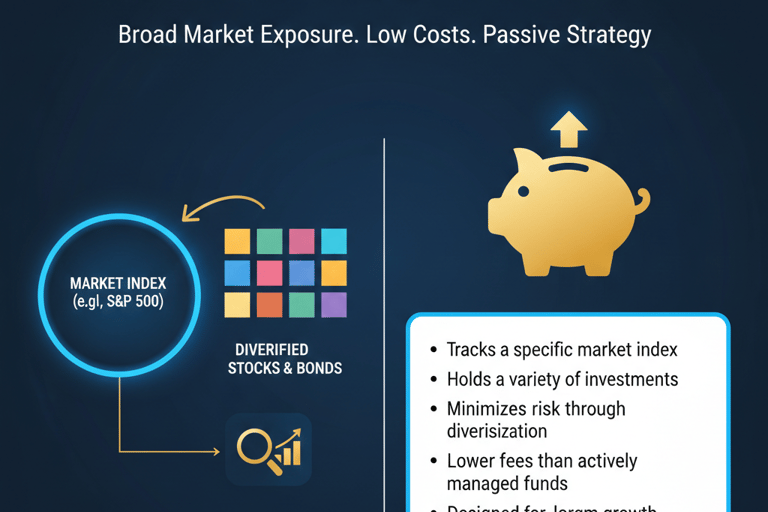
What Is an Index Fund?
An index fund is a type of mutual fund or exchange-traded fund (ETF) that aims to replicate the performance of a specific market index. Instead of trying to beat the market, an index fund simply follows an index.
flixah developers
1/31/20263 min read
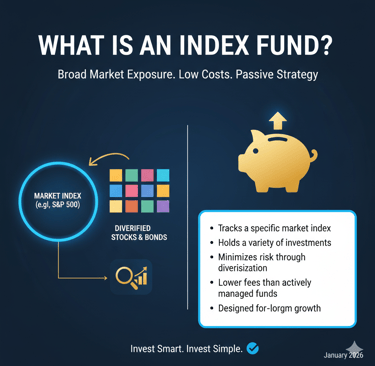
What Is an Index Fund?
An index fund is a type of mutual fund or exchange-traded fund (ETF) that aims to replicate the performance of a specific market index. Instead of trying to beat the market, an index fund simply follows an index.
For example:
Nifty 50 Index Fund tracks the Nifty 50
Sensex Index Fund tracks the BSE Sensex
Nifty Next 50 Index Fund tracks the next 50 large companies after Nifty 50
These funds invest in the same stocks and in the same proportion as the chosen index. If the index goes up, the fund value increases. If the index falls, the fund value also declines.
How Do Index Funds Work?
Index funds follow a passive investment strategy. This means there is no active stock selection by a fund manager. The fund automatically invests in companies listed in the index.
For example, if Reliance Industries has a 10% weight in the Nifty 50, the index fund will also invest around 10% of its total value in Reliance. This passive approach reduces costs and avoids frequent buying and selling.
Key Features of Index Funds
Low Expense Ratio
Since index funds are passively managed, they have very low management costs compared to actively managed mutual funds. This helps investors save more over the long term.Diversification
By investing in an index fund, your money is spread across multiple companies and sectors. This reduces risk compared to investing in individual stocks.Transparency
Index funds clearly disclose which index they track and which stocks they hold. There are no surprises.Market-Linked Returns
Returns depend on overall market performance. While they may not give extraordinary short-term gains, they perform well over long periods.
Advantages of Investing in Index Funds
One of the biggest advantages of index funds is simplicity. You don’t need deep market knowledge to invest. As long as the economy grows over time, index funds benefit from that growth.
Another major benefit is consistent performance. Studies have shown that most actively managed funds fail to beat the market over the long term. Index funds, on the other hand, always deliver market returns.
Index funds are also excellent for long-term goals such as retirement planning, children’s education, or wealth creation. When combined with SIPs (Systematic Investment Plans), they help investors benefit from rupee cost averaging and compounding.
Risks Involved in Index Funds
Although index funds are considered relatively safe, they are not risk-free. Since they are market-linked, they can decline during market downturns. In the short term, returns can be volatile.
Also, index funds do not provide downside protection. If the index falls sharply, the fund will also fall. However, over long periods, markets have historically delivered positive returns.
Index Funds vs Actively Managed Funds
The main difference between index funds and actively managed funds is the investment approach. Actively managed funds rely on fund managers to select stocks, which increases costs and risk of underperformance. Index funds eliminate this risk by simply tracking the market.
For investors who prefer stability, lower costs, and predictable performance, index funds are often a better choice.
Who Should Invest in Index Funds?
Index funds are suitable for:
Beginners who want a simple investment option
Long-term investors with a 5–10 year horizon
Investors looking for low-cost investments
People who prefer a passive investment strategy
They are especially ideal for salaried individuals who want to invest regularly without actively tracking the stock market.
Conclusion
Index funds are one of the most efficient and reliable investment options available today. They offer low costs, diversification, transparency, and long-term growth potential. While they may not generate quick profits, they are excellent tools for building wealth steadily over time.
For investors who believe in long-term market growth and want a stress-free investment journey, index funds are truly a smart choice.
please consider our real estate investment venture option of FlixahMadharam
for more info on real estate investment you can visit us website flixahdeveloperspvtltd.com and you can also reach us at +91 9100600730,